
Hundreds of Permit Holders Delayed as Safety Teams Assess Blockage
Kathmandu, Nepal — A colossal block of ice the size of a 10-story building has shut down Mount Everest’s primary climbing route, leaving at least 410 climbers stranded at Base Camp with no clear timeline for their ascent.
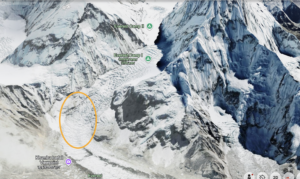
The unstable ice formation, called a serac, was discovered in the treacherous Khumbu Icefall on April 10 and officially declared unsafe on April 24, 2026. It now blocks the route approximately 1,000 feet below Camp One, forcing a complete halt to climbing operations during the critical spring season.
“Expeditions are all being delayed because of the impasse,” said Garrett Madison of Madison Mountaineering, speaking from Base Camp. Among those waiting are 98 climbers from China, 49 from the United States, and 46 from India. Each has paid $15,000 for a permit to attempt the 29,032-foot summit.
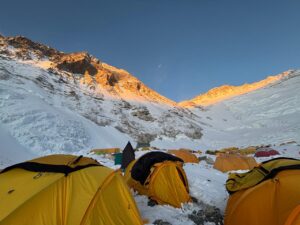
Climber Purnima Shrestha is currently at Everest Base Camp, awaiting the preparation of the climbing route.
Timeline: How the Crisis Unfolded
April 10: Experienced Sherpa mountaineers known as Icefall Doctors discovered the massive serac during their seasonal route-preparation work.
April 10-23: Safety teams assessed the blockage and determined it posed an immediate collapse risk to climbers passing beneath it.
April 24: Officials declared the route unsafe, effectively closing Mount Everest to all climbers attempting the Nepal side of the mountain.
Current Status: Safety specialists are now weighing two options—finding an alternate route through the Icefall or waiting for the serac to collapse naturally as temperatures rise.
The Location: Heart of the Danger Zone
The serac sits in the Khumbu Icefall, located above South Base Camp and approximately 1,000 feet below Camp One. This section of the mountain is already notorious as one of the world’s most dangerous climbing passages.
The Khumbu Icefall is the mandatory gateway for anyone attempting Everest from Nepal. Climbers must pass through this unstable maze of towering ice blocks, hidden crevasses, and rapidly moving glaciers just to reach Camp One. It’s unavoidable and it’s unforgiving.
What Is a Serac? Understanding the Threat
A serac is an enormous block of ice created when glaciers crack and shift as they move downslope. As the glacier advances sometimes several feet per day on Everest; these ice formations become increasingly unstable, eventually collapsing without warning.
The serac currently blocking Everest was discovered by the Icefall Doctors during their crucial April work preparing the climbing route. These experienced Sherpa mountaineers assessed it as too dangerous to climb beneath. Their assessment proved correct: by April 24, it was officially declared unsafe.
“It could fall soon or it could take some time,” Reuters reported from contacts on the mountain.
The danger is real. Seracs and crevasse collapses in the Khumbu Icefall have killed numerous climbers. Most notably, in 2014, a massive icefall collapse killed more than a dozen sherpas a tragedy that remains the deadliest incident in Everest climbing history.
The Impact: Hundreds of Climbers in Limbo
The blockage hit during the most critical window of the climbing season. Mount Everest can only be safely climbed during a narrow weather window between April and May—just two months each year. The route typically opens by the third week of April.
With the closure now in effect, climbers are burning valuable days waiting at Base Camp with no certainty about when they can proceed.
Who’s Waiting?
The breakdown of stranded climbers by nationality tells the story:
- China: 98 climbers (including 24 women)
- United States: 49 climbers
- India: 46 climbers
- Other nations: 217 climbers
Each holds a permit costing $15,000, meaning the serac blockage has effectively locked up over $6 million in expedition investments.
Economic Fallout for Nepal
Mountain climbing is a major economic lifeline for Nepal, which is home to 8 of the world’s 14 highest peaks. The closure has immediate ripple effects across the Khumbu region: lodge owners, porters, guides, equipment suppliers, and trekking companies all lose revenue with each delayed or cancelled expedition.
What Happens Next? Two Paths Forward
Safety teams are now racing against the calendar. They face a critical decision that will determine whether hundreds of climbers get their summit attempt or go home disappointed.
Option 1: Forge a New Route
The Icefall Doctors can attempt to establish a new path around the serac through untested ice. This requires fixing ropes, testing stability, and marking safe passages meticulous work that typically takes several days. Every day of delay eats into the narrow climbing season.
Option 2: Wait for Nature
As temperatures warm into late April, the serac may collapse on its own. Once it falls, the original route reopens. But timing is unpredictable – collapse could occur within days or take weeks.
“That means safety specialists will have to find an alternate route, or wait for the serac to melt enough to collapse on its own,” according to reports from the mountain.
Either way, expeditions already on thin margins due to the short season are now facing severe time pressure.
Why This Blockage Matters: Historical Context
While seracs appear regularly in the Khumbu Icefall, this particular blockage stands out for its size and timing. It’s arrived during the most critical climbing days of the year, affecting the largest number of permit holders in recent memory.
The risks are not theoretical. The Khumbu Icefall claims lives. In 2014, a massive ice collapse killed more than a dozen sherpas – the deadliest single incident in Everest’s modern climbing history. The seracs and crevasses here create hazards that no route can completely eliminate.
This is why the Icefall Doctors’ decision to declare the current serac unsafe is not cautious – it’s essential.
The Broader Challenge: Nepal’s Climbing Economy at Risk
For Nepal, this blockage represents more than a single climbing season disruption. Mountain expeditions generate crucial foreign currency and employment. The Khumbu region depends on the annual influx of climbers.
With 410 climbers currently stranded, and more still trying to get permits, the full economic impact won’t be clear until the situation resolves. If the blockage persists into May, when the weather window closes, dozens of expeditions may be abandoned entirely.
What We Know Right Now
- 410 climbers are at Base Camp with valid permits
- The serac was discovered April 10, officially closed the route April 24
- Safety assessment: Too dangerous to climb beneath
- Current status: Safety teams evaluating alternate routes
- Timeline: Unknown! could resolve in days or weeks