Every season, we watch the skies above the Khumbu Valley from our base in Kathmandu and Lukla. Helicopters are a routine sight here – ferrying trekkers to Everest Base Camp, evacuating altitude-sick climbers, or simply offering a bird’s-eye view of the world’s most iconic peaks. But one question keeps coming in from travellers worldwide: can a helicopter actually fly all the way to the top of Mount Everest?
The short answer is yes – but the full story is far more nuanced than that. As operators working in the Everest region year-round, we know these skies better than most. Here is what the science, the records, and the realities of high-altitude aviation actually tell us.
Can a Helicopter Actually Land on the Summit of Mount Everest?
Yes, a helicopter has landed on the – once, under extraordinary conditions. On May 14, 2005, French pilot Didier Delsalle touched down on the 8,849-metre (29,032-foot) peak of Mount Everest in an Eurocopter AS350 B3, setting a world record for the highest altitude helicopter landing ever achieved. He held the aircraft on the summit for just under four minutes before lifting off.
The feat was not a casual flight. It required months of preparation, a stripped-down aircraft, precise atmospheric timing, and a level of piloting skill most professionals never need to reach. Delsalle returned the following day to repeat the landing, further validating the record. It remains the only documented instance of a helicopter landing at Everest’s true summit.
Does this mean summit helicopter flights are a viable option for rescue or tourism? In practice, no. The conditions that made Delsalle’s flight possible: perfect weather window, minimal payload, a purpose-engineered aircraft aligned perhaps once in years. For routine operations in the Everest region, summit-level flights remain outside the reach of standard aviation.
What Is the Maximum Altitude a Helicopter Can Fly?
| Helicopter Type / Model | Typical Operational Altitude | High-Altitude Operational Range | Absolute Service Ceiling |
|---|---|---|---|
| Standard Commercial Helicopters | Up to 3,000–4,500 m (10,000–15,000 ft) | — | — |
| High-Altitude Models (e.g., Airbus H125, Bell 407) | Up to 5,000–6,500 m (16,400–21,300 ft) | Reliable under normal load | ~7,010–7,200 m (23,000–23,600 ft) |
| Record Performance (Delsalle, 2005, H125) | — | — | Exceeded 7,010 m in stripped configuration |
Why High-Altitude Flying Is So Demanding: The Science Behind It
Those of us who operate in the Himalayas see the effects of altitude on aviation daily. Understanding why helicopters struggle at extreme altitude is essential context for anyone planning a visit to the Everest region.
Thin Air and Reduced Rotor Efficiency
A helicopter generates lift by its rotors pushing against air. At sea level, air is dense enough that the rotor blades create strong upward force with each rotation. At 8,000 metres, air density is roughly one-third of what it is at sea level. The rotors must spin faster and work harder to produce the same lift and even then, the margins are razor-thin. In practice, this means every kilogram of unnecessary weight must be removed, and flight windows are limited to the calmest conditions.
Engine Output and Oxygen Deprivation
Turbine engines the type used in high-altitude helicopters require oxygen to combust fuel. As altitude rises, less oxygen is available, and engines produce progressively less power. Turbo-charged and specially tuned engines partially compensate for this, but there is a hard physical ceiling beyond which no engine can overcome the deficit. This is not a design flaw; it is a law of physics.
Extreme Weather and Unpredictable Wind
Mount Everest generates its own weather. Jet stream winds frequently batter the upper mountain, reaching speeds in excess of 200 km/h (125 mph) near the summit. Even at Base Camp altitude, sudden wind gusts, whiteouts, and rapid temperature shifts can ground flights with little warning. Our pilots monitor forecasts around the clock during peak seasons, and even then, schedules are regularly adjusted based on real-time conditions.
Record High-Altitude Helicopter Landings: Verified Milestones
Beyond Delsalle’s 2005 Everest summit landing, there have been other significant high-altitude helicopter operations worth noting. Rescue missions on Everest have reached as high as Camp 4 (approximately 7,950 metres / 26,082 feet) in critical emergency scenarios, though these are extremely rare and undertaken only when a climber’s life cannot otherwise be saved.
In 2012, a helicopter rescue mission reached above 6,700 metres on Everest to extract injured climbers considered one of the highest routine rescues on record at the time. The Nepalese Army aviation division and private operators based in Kathmandu, many of whom we coordinate with for Everest Base Camp helicopter tours, have built substantial experience in high-altitude operations over the decades.
Everest Base Camp Helicopter Tours vs. Summit Flights: Understanding the Difference
At Everest Hikes Pvt Ltd, we operate Everest Base Camp helicopter tours as a core part of our offering and they are genuinely spectacular. But it is important for travellers to understand what these tours involve versus what summit-level flights represent.
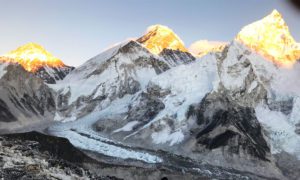
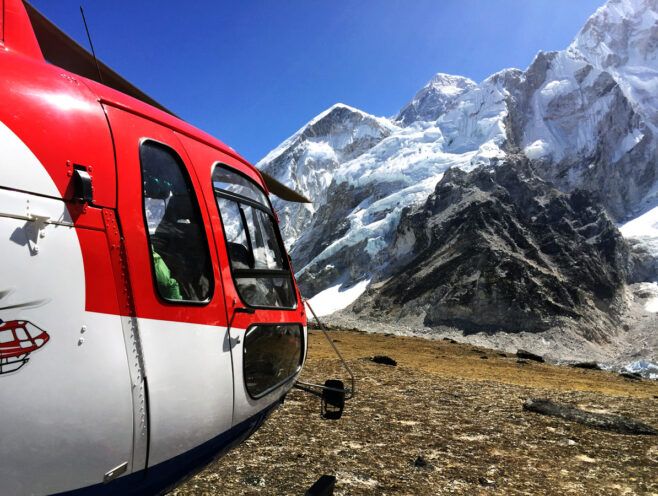
An Everest Base Camp helicopter tour typically flies to Everest Base Camp at 5,364 metres (17,598 feet), often with a stop at the Kala Patthar viewpoint at around 5,545 metres (18,192 feet) for panoramic Everest views. These flights depart from Lukla or directly from Kathmandu and can be completed in a few hours, offering some of the most dramatic mountain scenery on the planet without requiring weeks of trekking.
Summit flights operating at or above 8,000 metres are not part of any regular commercial aviation schedule. They are not offered as tourist products, and they are not safe to offer as such. The technical and atmospheric requirements place them firmly in the category of experimental aviation feats, not travel experiences.
If you want to see Everest from the air in genuine comfort and safety, an Everest Base Camp helicopter tour is the right choice. Our flights give you dramatic close-up views of the Khumbu Icefall, the Western Cwm, and Everest’s south face all from a pressurised cabin with an experienced pilot who knows these valleys intimately.
Safety and Rescue Operations in the Everest Region
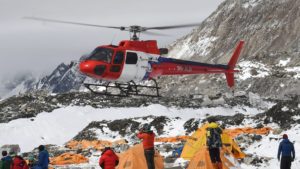
High-altitude helicopter rescue in the Everest region is a serious and well-established operation. Every climbing season, helicopters respond to medical evacuations from Base Camp and the lower camps, carrying altitude-sick trekkers, injured climbers, and emergency personnel. These missions are coordinated through Kathmandu-based operators, trekking companies, and the Himalayan Rescue Association.
The practical altitude limit for rescue operations under normal conditions is around 6,000 to 6,500 metres (19,600 to 21,300 feet). Above this, rescue helicopters can operate only in narrow weather windows with minimal fuel and zero extra passengers. Above Camp 3 on the standard South Col route roughly 7,200 metres self-rescue or assisted descent by other climbers is typically the only realistic option.
For trekkers visiting the Everest Base Camp region, helicopter evacuation is a genuine safety net. Travel insurance that covers high-altitude helicopter rescue is strongly recommended for all our clients. We coordinate directly with rescue services to ensure the fastest possible response if needed.
Our Verdict: Possible, But Rarely Practical
Can a helicopter fly on top of Mount Everest? Technically, yes Didier Delsalle proved it in 2005 with exceptional skill and preparation. But for all practical purposes, the summit remains beyond the reach of routine helicopter aviation. The physics of thin air, the demands on rotor efficiency, the unpredictability of Everest’s weather, and the sheer engineering challenge make it a once-in-a-generation feat, not an everyday possibility.
What is very much possible and deeply rewarding is an Everest Base Camp helicopter flight. At Everest Hikes Pvt Ltd, we have been operating in the Khumbu region for years, working with Nepal’s most experienced high-altitude pilots. Whether you are short on trekking time, returning from an expedition, or simply want to experience Everest from the air on your own terms, we are here to make it happen safely and memorably.
Contact our team today to plan your Everest helicopter experience. We handle everything from flight scheduling and permits to logistics in the Khumbu Valley so you can focus on the view.
Frequently Asked Questions
Q: Has a helicopter ever landed at the top of Mount Everest?
Yes. French pilot Didier Delsalle landed an Eurocopter AS350 B3 on the summit of Mount Everest on May 14, 2005, and again the following day. He remained on the summit for under four minutes on the first flight. This remains the only verified helicopter landing at the Everest summit.
Q: How high can a helicopter fly near Mount Everest?
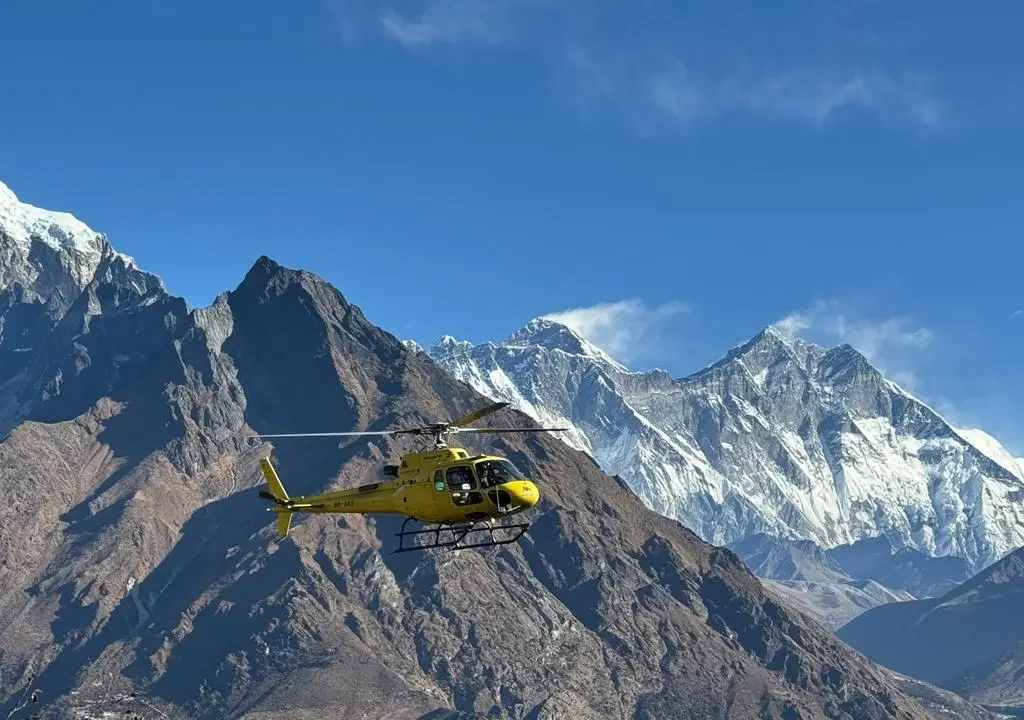
High-altitude helicopters used in Nepal, such as the Airbus H125, have a certified service ceiling of around 7,010 metres (23,000 feet). In practice, routine rescue and tourism operations in the Everest region are conducted reliably up to about 6,000 to 6,500 metres. Flights above this altitude require exceptional conditions and are not offered commercially.
Q: Can I book a helicopter tour to Everest Base Camp?
Absolutely. Everest Base Camp helicopter tours are one of the most popular experiences we offer at Everest Hikes Pvt Ltd. Flights typically depart from Kathmandu or Lukla, fly to Base Camp at 5,364 metres, and include scenic stops with views of Everest, Lhotse, Nuptse, and the Khumbu Icefall. The full journey can be completed in a single day.
Q: What helicopter is used on Mount Everest rescue missions?
The Airbus H125 (formerly AS350 B3) is the aircraft most commonly used for high-altitude helicopter rescue in the Everest region. Its powerful turbine engine, lightweight frame, and high-altitude performance make it the best-suited helicopter for operations in Nepal’s Himalayan terrain.
Q: Is it safe to take a helicopter to Everest Base Camp?
Yes, when conducted by reputable operators with experienced pilots and proper safety protocols. At Everest Hikes Pvt Ltd, we work only with licensed Nepalese aviation companies and pilots with extensive high-altitude experience. Flights are weather-dependent and are postponed whenever conditions are not safe. We recommend all passengers carry comprehensive travel insurance covering high-altitude helicopter evacuation.